

 (01) 45 33 108
 - Systems Design
- Installation
- Cylinder Testing
- Integrity Testing
- Maintenance
- 24hr Call Out
- For other divisions in the group, please click on the links below


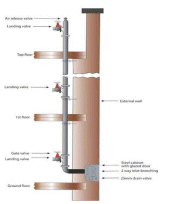
Dry/Wet Riser Sprinkler System/Fire Hydrants/Hose Reels
Dry & Wet Risers
Dry/wet risers are intended for the use of the Fire Service to provide a readily available means of delivering considerable quantities of water to extinguish or to prevent the spread of fire. If your fire risk assessment concludes that you may need the intervention of the Fire Service to fight a fire, you must ensure that your riser systems or hydrants are working properly. Before installation of dry or wet rising mains, the local Authority and Fire Officer must be consulted to ascertain their exact requirements. Dry risers will be found:
• In buildings over 18 metres above ground level.
• In low level buildings where there are excessive distances from entrances (60m)
Wet risers will be found in buildings over 60 metres above ground level.
Difference between dry riser and wet riser
Dry riser: A system consisting of valves and pipe work enabling the Fire Service to pump water on to upper floors of a building.
Wet riser: A system consisting of valves and pipe work which are kept permanently charged with water.
Why do dry/wet risers need to be serviced?
•Risers are prone to neglect and vandalism
• Severe penalties should the rising main fail to work for the Fire Service
• leaking from a wet riser could cause substantial damage BS 5306 Part 1 recommends for dry risers:
• A visual inspection every six months
• An annual pressure test as per BS 5306 Part 1 recommends for wet risers:
• 2 visual inspection services per year
• 2 electric pump inspection services per year
• 1 flow test per year (if applicable)
Dry Riser
Automatic Fire provides two types of service in accordance with BS5306 Part 1:
• Visual inspection service
• Annual pressure test service (which includes a visual inspection Service)
Wet Riser
Automatic Fire provides three types of service in accordance with BS 5306 Part 1:
• Visual inspection service
• Electric pump service
• Flow test
FIRE HYDRANT
A fire hydrant is a pipe that allows water to flow from a water main with the control of a valve in order to put out a fire.
Maintenance & Inspection
Weekly
Inspections should be carried out to ensure the hydrants are not obstructed and all indicator plates are in position.
All valves should be checked to ensure they are in the correct orientation.
Annually
All hydrants should be serviced annually to ensure they are in good serviceable condition.
A flow test should be carried out to determine any deterioration in flow/pressure. Flushing is also done to remove sediment from the pipes in order to maintain water clarity and quality in the distribution pipes.
All valves should be checked to ensure they are in the correct orientation.

Underground British Fire Hydrant
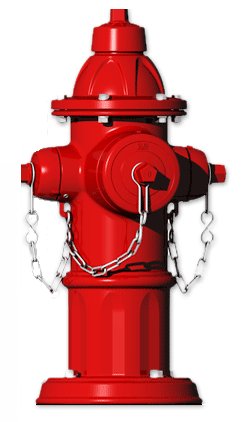
Above Ground Pillar Hydrant
Fire hose reels are located to provide a reasonably accessible and controlled supply of water to combat a potential fire risk. The length of a fully extended fire hose is 36 meters with a diameter of 19mm (outside diameter). These appliances are designed to deliver, as a minimum, 0.33L of water per second. A control nozzle attached to the end of the hose enables the operator to control the direction and flow of water to the fire. All fire hose reels come with a unique ball valve shut-off device, a plastic or solid brass hose reel nozzle and mounting bracket.
Hose Reel Maintenance and Inspection
Monthly
All hose reels should be inspected and particular attention made to ensure there are no leaks and the drum rotates freely on its spindle.
Annually
Run out hose fully, under pressure and check for crack, splits, leaks or other damage.
Carry out a flow and pressure test.
Check the drum rotates freely on its spindle and for swinging hose reels that it swings through 180° easily.
Inspect any nozzles and isolation valves and check they work correctly, are easy to operate and that they are left in the correct orientation.
Check any guide is fixed securely and it works correctly.