

 (01) 45 33 108
 - Systems Design
- Installation
- Cylinder Testing
- Integrity Testing
- Maintenance
- 24hr Call Out
- For other divisions in the group, please click on the links below


 A History of Fire Sprinkler Systems
A Brief History
From 1852 to 1885, perforated pipe systems were used in textile mills throughout England as a means of fire protection. However, they were not automatic systems; they did not turn on by themselves. Inventors first began experimenting with automatic sprinklers around 1860. The first automatic sprinkler system was patented by Philip W. Pratt.
Henry S. Parmalee of New Haven, Connecticut is considered the inventor of the first practical automatic sprinkler head. Parmalee improved upon the Pratt patent and created a better sprinkler system. In 1874, he installed his fire sprinkler system into the piano factory that he owned.
Until the 1940s, sprinklers were installed almost exclusively for the protection of commercial buildings, whose owners were generally able to recoup their expenses with savings in insurance costs. Over the years, fire sprinklers have become mandatory safety equipment, and are required by building codes to be placed in hospitals, schools, hotels and other public buildings.
Usage
Sprinklers have been in use in the United States since 1874, and were used in factory applications where fires at the turn of the century were often catastrophic in terms of both human and property losses. In the US and Europe sprinklers are today required in all new high rise and underground buildings generally 23 Metres (75 feet) above or below fire department access, where the ability of firefighters to provide adequate hose streams to fires is limited. Sprinklers are also required in hazardous storage spaces by building codes, or may be required by insurance companies where liability due to potential property losses or business interruptions can be reduced by adequate automatic fire protection.
Building codes in Ireland for places of assembly, generally over 200 persons, and places with overnight sleeping accommodation such as hotels, nursing homes, dormitories, and hospitals usually require the installation of sprinklers to be considered. A newer, special class of fire sprinklers, ESFR sprinklers, has been developed to fight, and subsequently suppress high challenge type fires.
Sprinkler Heads - New and Old
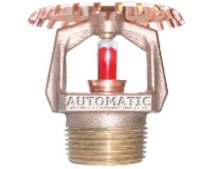
Since the introduction of Sprinklers, there have been many changes in the styles and usage of sprinkler heads. Below are some old and some new sprinkler heads.
|
|
|
|
|
|
Chrome Finish |
Brass Finish |
Concealed |
Chrome Finish |
|
|
|
|
|
|
W. Kane |
Mackey |
Pendent/Upright |
Rundle Spence |


Fire Sprinklers operate automatically in the area of fire origin, preventing a fire from growing undetected to a dangerous size, while simultaneously sounding an alarm.
Taking the statistics gathered in Europe over the last 10 years, they show that in fully sprinklered premises:
99% of fires are controlled by sprinklers
93% of fires are controlled within the design area of operation of the system
60% of fires are controlled by four sprinklers or less.
All fire safety measures have a reliability factor. Walls, ceilings and floors may have barriers penetrated by ducts, conduits and cables. Exit doors may be blocked or locked to 'improve' security. Windows may be broken.
Fire Sprinklers are the most reliable active fire protection system known. Detailed fire records from Australia and New Zealand, where all fires must be reported, reveal that in the period 1886 -1986 some 9,022 fires occurred in sprinklered premises. Of these, just 49 were not controlled by the fire sprinkler system, resulting in a success rate of 99.5%.
In this 100 year period there were 11 fatalities, 7 of which were as a result of explosion.
In the UK the number of fires reported in sprinkler controlled buildings over a 12 year period during the 1970s and 80s was 16,800. Almost half of these were controlled by 1 or 2 sprinkler heads